I'm a professional organizer and my motto is simple: Reduce the mess. Arrange the rest. Maintain the calm. I believe in creating organization systems that actually work for you because every family is unique, and one-size-fits-all solutions just don’t cut it. As a mom myself, I get how crazy life can get so let’s tackle the mess together and find a system that sticks!
Organizing all of these piles and finding a home for them is the crucial last step. Without a home, you won’t be able to keep up the routine of putting papers in their home spot. You need to figure out a system that works for you and your life. It will likely change over time.
Some people may want to do a shred box that you shred when it gets full, while others can shred as they go. Each kid may have their own bin with one hanging file folder for each school year to save the best of the best while other parents would prefer to keep everything saved electronically.
Using a simple organizing system for papersand tailoring it to your life ensures it works long-term.
I know these 4 simple steps make it look like it should be easy, but I know that it is a daunting job to go through all of those papers! I know that you may get stuck at some point.
But keep moving forward, even as few as 5 papers a day will eventually make progress and you may even get some momentum! Even small organizing habits for busy moms make a huge difference in managing paperwork.
Start today by tackling just one pile or one type of paper — small wins add up quickly and create a calmer, more organized home.
I’m Maggie, owner of Organizing CU and a busy working mom who understands the struggle of trying to juggle all of it. Using my Reduce, Arrange, Maintain philosophy, I can help you get and stay organized!
(Prefer to listen to all the steps in one place? Check out the second episode of the Organizing Confidence Unlimited podcast.)
Now that we’ve done step 1 (Find), step 2 (Initial go-thru), and step 3 (Sort), you have five piles of keep, the next step is to go through each of those piles and find a permanent home for them. If you can do several of them in a night, great. Just make sure you take a break after each one.
If you’re short on time and can do just one a night, no big deal. This should work within your time constraints. Again, you may run into more shredding and recycling, which is great! Remember our key question throughout this paper organizing process: “What do I need to keep?” (one of my core principles of creating a simple organizing system for papers).
Your active pile will be the most fluid with stuff going in and out frequently. Try to keep a small basket in a set location, such as on your desk or in the corner of your kitchen.
Pro tip: Schedule a time each day/week/every other week to go through the papers and toss/shred/ file anything that you need to keep. Personally, I keep a small paper holder in my kitchen and go through it every couple of days. That may be too often for you.
You can use an expanding file for the current folder. I’ve also used these in a filing cabinet with a “Current” label. Again, this one will have some in and out documents. Take a look at the documents you have in there and that may lead you to the right place to store them.
Long term storage can be kept in a filing cabinet with labeled hanging file folders so you can easily file anything away. You may prefer to scan these items and keep them saved electronically. If that works for you, awesome! As I’ve said before, I’m a paper girl so I don’t keep too much saved electronically, but that’s just personal preference.
For the sentimental stuff, we like to keep bins in our storage area (basement for us, but it could be your attic, garage, under bed). If you are short on space, you may want to go through them yearly and clean out anything that is outdated or that you no longer think you’ll need.
Each person gets a set amount of space: one bin for each person (space limits found here and also in episode 6 of the Organizing Confidence Unlimited podcast). Again, electronic storage is a great option for this. I keep all of my kid’s art stuff saved in a folder on Google Drive, then I don’t feel bad when it doesn’t make it into her scrapbook or to a grandparent.
With receipts, I keep all of the current month’s receipts in envelopes (one for each account) and then reconcile them with my bank statements once a month. Anything that may have a return at some point, such as Wal-Mart, Target, Lowes, etc, I move to a new envelope that is “Saved for returns.” Every couple of months, I clean that out.
Since most of our stuff is groceries and food, it’s a very small folder. You may want to just keep a folder for the possible returns and not worry about the rest. Again, that’s totally up to you!
The best part of this step is that you can totally customize it to fit your life! If your family doesn’t keep receipts, then don’t keep them! If you already have bins in the basement for some of your sentimental stuff, then go through them and purge/add as necessary. If you have a place that paper tends to pile up at, then add an inbox right there.
This is the part that you can customize to your life, which is a great way to make it a habit, the key to building lasting organizing habits for busy moms.
Start today by picking just one pile to put in a permanent home — these small organizing wins add up quickly and create a calmer, more manageable home.
I’m Maggie, owner of Organizing CU and a busy working mom who understands the struggle of trying to juggle all of it. Using my Reduce, Arrange, Maintain philosophy, I can help you get and stay organized!
(Prefer to listen to all the steps in one place? Check out the second episode of the Organizing Confidence Unlimited podcast.)
Now that you’ve done step 1 (Find) and step 2 (Initial go-thru), and you’ve gotten rid of the shred and recycling piles, you are left with only the keep.
This will likely be the hardest step for most people.
Go through them and Sort everything into one of five piles:
Active (‘to do’ items like bills to pay, RSVPs, rebates, forms to fill out and mail back)
Current (‘use for the near future’ like tax docs, sports calendars, paid bills from last 3 months)
Long term storage (previous tax returns, medical records, warranties)
Sentimental (old papers you wrote in college, kids artwork)
Receipts
Keep in mind, you may now be in the mindset of tossing stuff and you need to create more shred/recycle piles. If so, that is awesome! Remember our mindset shift: “What do I need to keep?” instead of “What can we get rid of?”
Like I said, this one will be the most daunting one. For every 30 minutes you work, take a 5 minute break! Sorting everything in one night may not be possible and that’s fine! There is no need to rush through all of this! As long as you continue to make progress, you’re moving in the right direction!
Using a simple organizing system for papers and pacing yourself makes this big task manageable. Start today by tackling just one category or one pile as each small win brings you closer to a clutter-free, organized home.
I’m Maggie, owner of Organizing CU and a busy working mom who understands the struggle of trying to juggle all of it. Using my Reduce, Arrange, Maintain philosophy, I can help you get and stay organized!
(Prefer to listen to all the steps in one place? Check out the second episode of the Organizing Confidence Unlimited podcast.)
In step 1, we put everything in a huge bin (Find). This next step is doing an Initial go-thru putting everything into three bins: keep, recycle, and shred.
Decide for yourself on the best time and place to work on sorting. Typically, I like to do all of the organizing in the house by myself, but you may want or need some family member’s input on this step. I prefer to do this when my husband is watching TV that I have zero interest in, such as basketball games. He’s nearby in case I need his input on a certain document, but he is not getting in my way!
For this step, it is absolutely key that you DO NOT SORT THE KEEP PILE NOW! I repeat, DO NOT SORT THE KEEP PILE NOW!
As a client recently told me, this is where she was getting hung up before we worked together. She was trying to sort as she went through everything.
Types of items in the recycle pile: junk mail, old lists, old catalogs, expired coupons, old magazines
Types of items in the shred pile: outdated bills, old receipts, bank statements, investment/retirement statements over a year old
Remember our key question from step 1: “What do I need to keep?” instead of “What can we get rid of?” If you’re unsure, put it in keep since the next step is sorting that pile.
As soon as you have these three piles, stop. DO NOT SORT THE KEEP PILE NOW. Take a break and move the recycle pile to the recycling bin and shred all the stuff you can.
Now go take a break before you tackle the next step – you deserve it!
Using a simple organizing system for papers and following these steps in manageable chunks can make a huge difference. Every small organizing task for busy moms can help turn paperwork chaos into a calmer, more controlled home.
Start today by sorting just one section of your paperwork. Tiny wins like this lead to big results and less stress in your home!
I’m Maggie, owner of Organizing CU and a busy working mom who understands the struggle of trying to juggle all of it. Using my Reduce, Arrange, Maintain philosophy, I can help you get and stay organized!
(Prefer to listen to all the steps in one place? Check out the second episode of the Organizing Confidence Unlimited podcast.)
I want to share the system that I find works the absolute best when you feel overwhelmed by all the papers in your house. There is a fair amount of stop and go with this technique, which makes it a more-than-one day-project, but it will stop you from feeling overwhelmed and let’s be real – your papers didn’t get like this in just one day!
As you’re going through this process, walking away and coming back fresh is a HUGE help when going through piles of paperwork. It may make one part of your house a mess for a few days or weeks, but it’s a fair price to pay to get it all under control and to get your new system in place to avoid this in the future! Using a simple organizing system for papers can save time and reduce stress long-term.
The question I want you to remember throughout is “What do I need to keep?” instead of “What can we get rid of?”
It’s a small shift that will pay dividends for your mindset when tackling a huge project like this! You’re then thinking of getting rid of everything, unless you need it for a certain reason. You are setting yourself up for success.
Let me reassure some doubters by saying that I’m not a paperless person. I still get my bills sent to my house (though I pay them online). My mind and system work better with physical reminders of my tasks, not electronic ones. However, this technique could also be used if you want to go paperless. Once you get to the end, you can scan all the documents and save them electronically and then create an upkeep system.
The acronym I use is FISH. Find, Initial go-thru, Sort, Home.
The first step is to walk around your house and find every sheet of paper and put it in one bin such as a laundry basket. Find every single one and toss it in. Go through every filing cabinet, every drawer, and every shelf. And then stop. Don’t do anything else. Give yourself some time to be in the right mind space for the next step! As more mail and papers come in this week, go through it as best as you can and toss them into the basket as well.
Paperwork is one of the toughest areas of the home to get under control. Every small organizing task for busy moms can make a huge difference when tackling papers.
Start today by picking one pile or one area of paperwork to tackle — small wins like this add up and create a calmer, more organized home.
I’m Maggie, owner of Organizing CU and a busy working mom who understands the struggle of trying to juggle all of it. Using my Reduce, Arrange, Maintain philosophy, I can help you get and stay organized!
You are probably living with toys all over your house: in the family room, on the kitchen floor, in every bedroom. When you’re on top of it and you get the entire house picked up, BOOM! Everything manages to come back out before you can make yourself a cup of tea (or pour a glass of wine) to celebrate. Every birthday and holiday brings more and more gifts and toys into your house with no hope of ever keeping up.
Imagine this instead: the kids are in their playroom, taking out blocks from their designated container, building towers together for 20 minutes by themselves before cleaning them up and putting everything back on the shelf.
Short of getting rid of most of the toys when the kids aren’t looking (which certainly has some advantages!), you’ve got to come up with a plan to deal with the incredible amount of stuff that kids have.
Creating a family-friendly organization system for toys can save time and reduce stress for everyone.
My two part technique is to do toy rotations for babies and toddlers and organizing toys by type for older kids. Toys are easier to locate when kids want to play and easier to pick up when they’re done. When they have less choice and less stress, everyone is happier.
(Want to hear more? Listen to episode 12 of the Organizing Confidence Unlimited podcast!)
For younger kids, especially the immobile ones, I recommend a toy rotation. You put one type of toy in each box (one touch and feel book, one board book, one car, one rattle, one teether, one stuffed animal). You rotate through 4-5 boxes, swapping the bin out for a new one every day, week, or whenever you remember.
As your kid gets older, you can switch what’s in the bins so they can make new combinations of toys: balls in the stacking cups, then next week, stuffed animals on top of the stacking cups.
While you can try the toy rotation if you have older kids, but they tend to notice (and comment!) if something specific is gone. I recommend keeping their absolute favorites always out and then separating other toys by category.
To do this, take out all the toys and separate them into groups that your kids understand. Maybe you’ll do balls in one, cars in another, art supplies in a third, and dress up in a fourth. The kids can pick and choose which specific bin they want to play with at the moment.
The key to both toy rotation and toy compartmentalization is that they must pick up each bin before getting out a new one! If your kids are struggling with the idea, read about toy time-outs and how you can make kids more accountable. Every small organizing habit for busy moms can make toy cleanup manageable and keep your home calmer.
Start with one rotation or one organized bin today — tiny changes like this add up to big wins and a happier home for the whole family!
I’m Maggie, owner of Organizing CU and a busy working mom who understands the struggle of trying to juggle all of it. Using my Reduce, Arrange, Maintain philosophy, I can help you get and stay organized!
When you look around your house as you begin to declutter, you will see something that you initially refuse to part with because either you or someone else spent a lot of money on it.
Please feel free to donate any tiaras you have around your house that you no longer wear (Full disclosure: I have one in my house that I refuse to donate.*)
“It’s too nice to donate” you think. Spoiler: nothing is too nice or expensive to donate. If it has run its course in your house and your life, you are free to let it go. You don’t need to hold onto something because it was expensive.
When you come across this situation, ask yourself these questions: would I keep it if it were originally free? And would I bring it to my house today, even if it were free?
You should not hold onto something that is taking space in your house simply because of its price tag. Period.
The other common excuse I hear is “Someone gave that to me, so I need to keep it.” Unless it’s a family heirloom, don’t think twice. (Please ask your family before donating any heirlooms!)
Would you expect someone to keep a book you gave them three years ago if they were done reading it? Realistically, how many of the gifts you’ve given do you keep tabs on?
If you’re really not sure about something, put a box or designate an area in your house as a donation spot. My closet has a corner on a shelf that allows me to keep a pile of things that need to go to Goodwill. When it gets full, everything goes.
Personally, I know that once something is in the pile, it’s on its way out the door. Some people may be more likely to remove stuff after it’s been put there. Having a system is a great first step! Using a simple organizing system for donation items is a great first step.
Using the questions above, take another look at your home and the stuff that is filling it up. Once you stop attaching monetary value to donation items, it gets much easier to let them go.
Every small decluttering task for busy moms can create big shifts in how your home feels.
Start today by choosing one item you’ve been holding onto and set it on its way out. Tiny wins like this lead to a calmer, more organized home.
*I was not joking. It says ‘Mother to be’ and was given to me at my baby shower, which I later took to the hospital and wore during labor.
I’m Maggie, owner of Organizing CU and a busy working mom who understands the struggle of trying to juggle all of it. Using my Reduce, Arrange, Maintain philosophy, I can help you get and stay organized!
Growing up, everyone in my family knew dad’s keys and money clip were kept on top of the refrigerator. I remember looking up to see if his keys were up there before looking around the house. If he was home, they were up there; no keys, no dad.
At the same time, no one ever knew where mom’s keys and purse were: in her pocket of yesterday’s coat, near the door, on the kitchen counter, on the dining room table…somewhere in the house was usually a good bet. You always had to shout to find out if mom was home!
Nowadays, my family has a landing zone in our mud room where my purse, husband’s wallet, and our keys stay.
For us, we have a getting home routine: come in, shoes come off, purse and wallet go on the table, and keys get hung on hooks. I go through my bag(s) and take everything into the kitchen that I need to go through tonight, such as mail, notes from school, or papers from work.
Creating a family-friendly organization system like thismakes life so much simpler.
This routine helps keep our entire family organized. Our mornings are much smoother because the same landing zone also acts as a departure area. If I need to take some papers to work, they go on the mudroom table. Books need to go back to the library? Same place.
Throughout the day and night, items get placed there for the next time we leave the house. It take a lot more brain space to have to remember: “what do I need to take to school and work?” versus “Pack up what’s on the table.” Every small organizing habit for busy moms can save time and reduce stress.
Having a set departure area makes it much easier to ensure we have everything we need when we leave the house. There is never a “where are my keys” moment in the morning because they are always right where they belong.
Start today by creating one simple landing zone in your home — a small habit can make mornings and evenings flow so much more smoothly!
Looking for more than a landing zone and instead a full-on command center? Listen to episode 26 of the Organizing Confidence Unlimited podcast!
I’m Maggie, owner of Organizing CU and a busy working mom who understands the struggle of trying to juggle all of it. Using my Reduce, Arrange, Maintain philosophy, I can help you get and stay organized!
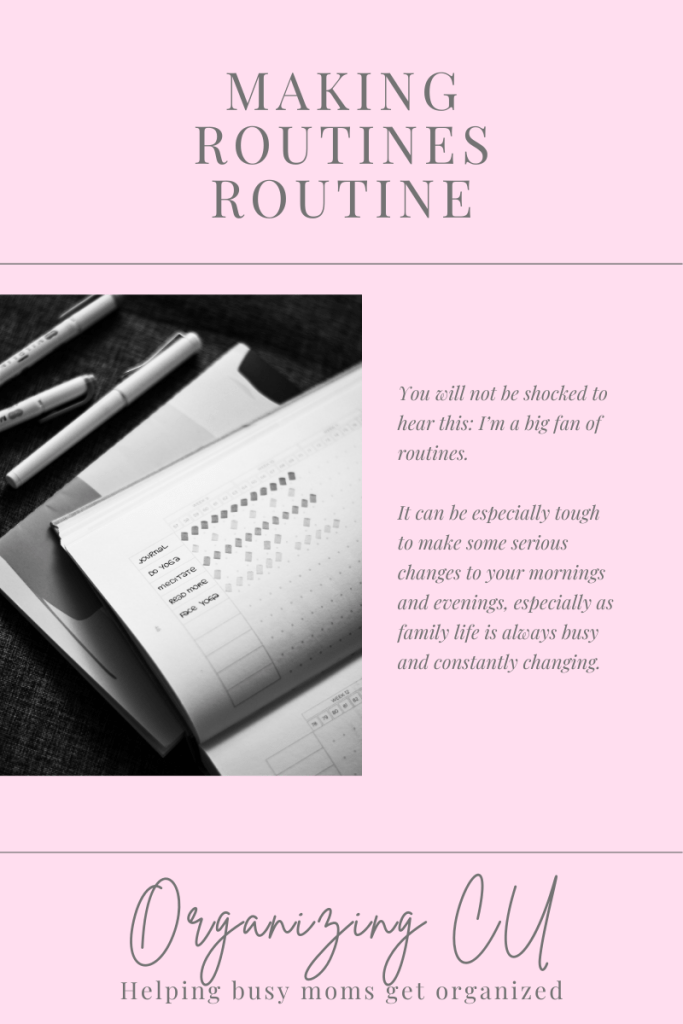
You will not be shocked to hear this: I’m a big fan of routines. Our family has routines for school days, weekends, grocery shopping, bed time, cleaning the kitchen after dinner… just about anything and everything.
But, trying to keep a structured routine with a family can be, well, trying. Since it takes on average 66 days to form a new habit, it can be especially tough to make some serious changes to your mornings and evenings, especially as family life is always busy and constantly changing.
If you’re struggling to get ready on time and are always rushing, check your routine (or lack thereof).
Creating simple organizing habits that make your home run smoother can take some pressure off your day.
You may find that some small changes can make a huge impact on your daily life. Think about what your ideal morning and evening would be like. Would they look something like this?
Morning:
Make bed
Wash and put away dishes (or run dishwasher)
Wipe bathroom & kitchen counters
Quick 2 minute pickup
Check calendar
Evening:
Wash dishes and run dishwasher (or put away dishes)
Wipe kitchen counters and sink
Sweep kitchen
Take out trash
Clothes (do a load, put dirty in hamper, put clean away)
Go through mail
15 minutes pick up blitz
Set up coffee
Pick out clothes
Make lunches and pack bags
Take a look at what you’re doing now and compare it to how you would like it to look. Maybe there are some things on your list that can be shifted from morning to the night before to help your AM run a little smoother. Give it a try for 66 days and see if it makes a difference.
These family-friendly organization routines can be real game-changers once they stick.
Building routines isn’t about perfection — it’s about creating tiny moments of calm that add up. Start with one habit today and let the momentum carry you forward.
Looking for more? I cover daily routines in episode 15 of the Organizing Confidence Unlimited podcast.
I’m Maggie, owner of Organizing CU and a busy working mom who understands the struggle of trying to juggle all of it. Using my Reduce, Arrange, Maintain philosophy, I can help you get and stay organized!
Temporary items become permanent clutter when you neglect regularly sorting an active space.
-Marcia Ramsland, Simplify Your Space
I read this quote recently and tried to look around my house with fresh eyes and see if there was anything that I had grown blind to. Sure enough, it took three seconds to find something: on the bookshelf, four feet from my spot on the couch, sat two old laptops. I had previously messaged one of my brothers about how to wipe them two months ago.
I’m not much of a procrastinator and my house is pretty well kept, so that is huge to me! When I first put them there, I thought it was a great place because it would serve as constant reminder to me that I need to do this right away. Clearly, that plan did not work because I began to ignore them very soon after that.
TWO MONTHS of clutter in the middle of our living room. A temporary item becoming permanent clutter.
I tried to look at the root of the problem as to why I didn’t just wipe them both clean that day and Google a spot to drop off old electronics*.
First, it was the instructions I was given: erase it, then overwrite it with the same thing over and over. I had already done the first part; I just wasn’t sure how to overwrite it. But I didn’t ask the very simple follow up question right then. Or anytime I thought of it. My brother works from home, is very available at any time, and we have messaged 100 times since then. (Full disclosure: it wasn’t until I got to this sentence in this post did I think “why not do it now?” It took him less than 5 minutes to respond to me and clarify in very simple terms what he meant.)
My goal is to get them wiped this week and have it in my donation pile for Goodwill by the weekend.
Everyone has areas or things in their house that they’ve just been neglecting or ignoring for a while. It might be two days, two months, two years, or twenty years. But it’s never too late to take a look around and see what permanent clutter you can cut out.
Even small decluttering tasks for busy moms can create a big shift in how a home feels.
Take a look around with a fresh set of eyes and see if you can find anything quick that you could donate or throw out today. You will be amazing at how much easier it is to relax in an emptier space. Why not do start now? These tiny wins add up quickly and can help you build simple organizing habits that last.
You’ve got this — one small declutter today brings you one step closer to the calm you deserve.
Looking for even more tips? I go in depth on permanent clutter during episode 22 of the Organizing Confidence Unlimited podcast.
I’m Maggie, owner of Organizing CU and a busy working mom who understands the struggle of trying to juggle all of it. Using my Reduce, Arrange, Maintain philosophy, I can help you get and stay organized!







 Organizing CU